Table of Contents
ToggleWhen a family goes through a separation, it is often the small daily habits that give children a sense of continuity. Among these, hair care – especially for curly or wavy hair – can become a reassuring moment, a ritual that remains the same whether they are at mum’s house or dad’s house, helping them feel seen and cared for.
Curly Hair and Self-Esteem During Family Changes
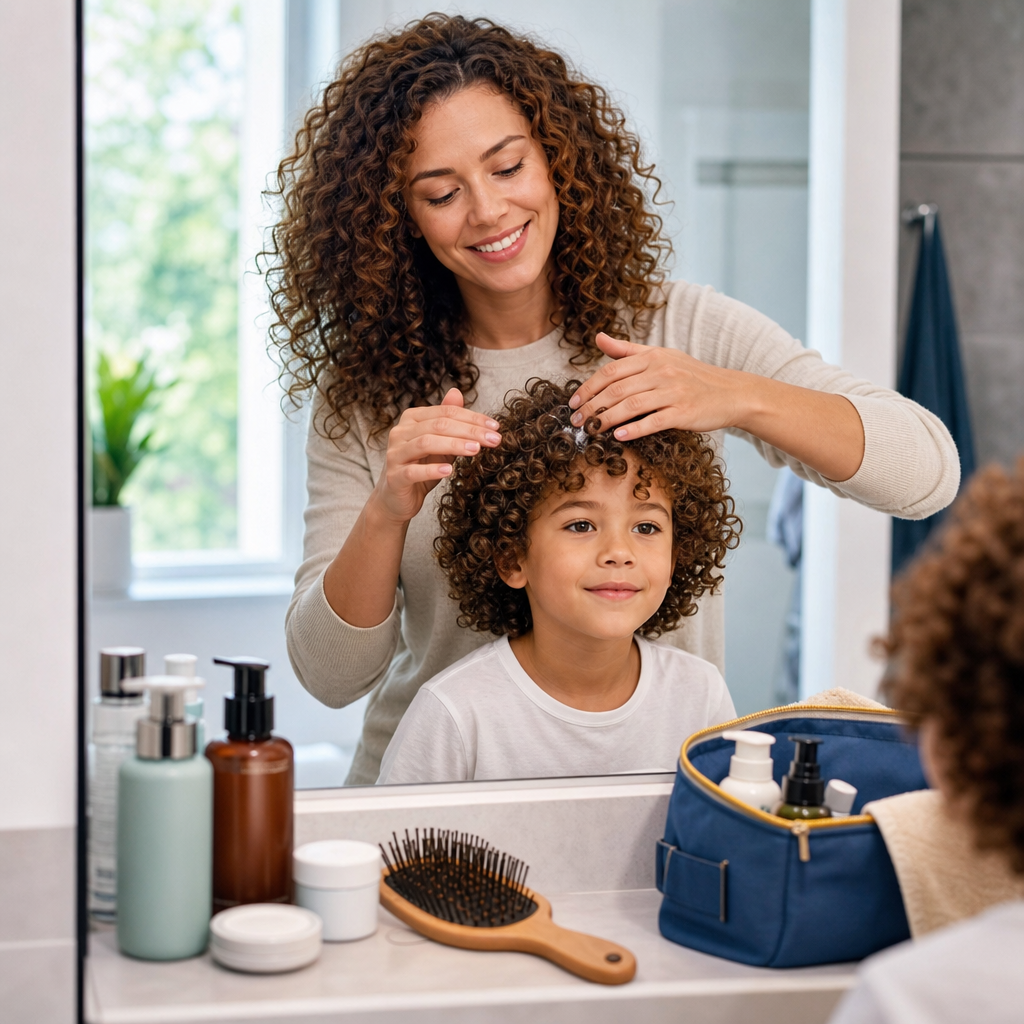
Curly hair is often an important part of a child’s or teenager’s identity. When they are also adjusting to life between two homes, being able to recognise themselves in the mirror can help maintain a sense of stability. A clear routine for washing, detangling and applying curl cream reduces stressful morning moments, arguments about knots and frizz, and reinforces the feeling of being valued and well cared for.
From an emotional perspective, spending a few minutes together tidying and caring for curls can become a valuable bonding opportunity. The parent listens, supports, and helps the child understand what they like about their appearance and which routines make them feel confident and comfortable. Repeating the same steps in both homes communicates consistency, even when family life has changed.
Creating a Coordinated Curly Hair Routine
For many separated parents, it helps to create a simple shared routine, perhaps written down and exchanged between households, so the child knows what to expect wherever they are. A typical routine for soft, defined curls may include a gentle shampoo, a nourishing conditioner left in for a few minutes, followed by a curl cream designed to enhance the hair’s natural pattern.
Products specifically developed for curly hair, such as Yuaia Haircare’s Twirl and Curl range, are formulated to provide hydration without weighing the hair down, control frizz, and leave curls feeling soft and manageable. For example, after gently towel-drying the hair, a parent can distribute a small amount of curl cream through the mid-lengths and ends, then “scrunch” the curls by lifting them upward with their hands. The same movements, repeated by one parent on Monday and the other on Thursday, become a shared language.
With older children and teenagers, sharing these instructions is also a way to encourage independence. Knowing how to use a quality curl cream correctly, how much product to apply, and when to refresh curls between washes helps them manage their appearance with confidence, without having to start over each time they move between homes.
Smooth Transitions and the Comfort of Familiar Items
Another important element for children of separated parents is the “transition bag” that travels with them between households. Including the same familiar items each time creates a sense of continuity: a favourite book, a beloved pair of pyjamas, a hairbrush they can use themselves, and their everyday personal care products. If the child has curls or waves, keeping their usual curl cream in the bag helps avoid last-minute substitutions, difficult hair days, and the feeling of being out of place.
Involving the child in packing the bag, checking together that nothing is missing, and deciding which items help them feel at home wherever they are can become a small exercise in self-awareness and confidence. Even details that may seem minor, such as the familiar scent of their hair products or the feeling of soft, well-defined curls, can make a meaningful difference to how they see themselves during a period of change. In this way, curly hair care stops being just another task for parents and becomes a practical source of everyday wellbeing for the whole family.